Enjoying a walk in your neighborhood or a jog through the local park should be a relaxing activity. We share our communities with dogs, and for the most part, these interactions are positive. But sometimes, an encounter with an unfamiliar dog can take a frightening turn. Even the most dedicated dog lover can be caught off guard by an aggressive animal.
That moment of panic when you realize a dog might become hostile is deeply unsettling. Your first instinct might be to scream or run, but those reactions can actually escalate the situation. Knowing how to respond calmly and safely can be the key to preventing a scary encounter from becoming a dangerous one.
This guide is designed to empower you with practical knowledge. It’s not about making you afraid of dogs, but about helping you feel prepared and confident. We’ll cover how to read a dog’s signals, what to do during an aggressive encounter, and the essential steps to take afterward.
Understanding Why a Dog Might Be Aggressive
To effectively handle a tense situation with a dog, it helps to understand what drives their behavior. Dogs don’t typically attack for no reason; they are usually reacting to a perceived threat or trigger. Their aggression is often rooted in instinct, not malice.
Common reasons for aggression include:
- Fear: The dog feels cornered or threatened by your actions, even if you mean no harm. Fast movements or approaching too quickly can be interpreted as a threat.
- Territorial Protection: The dog is guarding its space, its home, its puppies, or even its owner. You may have unknowingly crossed a boundary that the dog feels it must defend.
- Prey Drive: An instinct to chase can be triggered by running, cycling, or even high-pitched sounds. Fleeing from a dog can turn a simple chase into a more serious pursuit.
Recognizing these motivations highlights the importance of your own body language. How you carry yourself communicates whether you are a threat, prey, or something to be ignored. The goal is to appear as non-threatening and uninteresting as possible.
Phase 1: How to De-escalate an Encounter
Many times, a dog will give warning signs before it lunges. These signals can include deep growling, baring teeth, a stiff body posture, or intense barking. This is your critical window to de-escalate the situation and avoid a physical confrontation.
Rule #1: Do Not Run
This is the most crucial and counterintuitive step. Your survival instincts will scream at you to turn and flee, but you must fight that urge.
- Running activates a dog’s natural prey drive. A dog that was only intending to intimidate you might give chase simply because you ran.
- You cannot outrun a dog. They are significantly faster and more agile, and trying to escape on foot will likely end with you being caught from behind, in a very vulnerable position.
Stand Still and Be a “Tree”
If a dog is approaching you aggressively, your best defense is to become completely uninteresting.
- Freeze in place and stand still.
- Keep your arms hanging loosely at your sides.
- Avoid making any sudden or jerky movements.
By transforming yourself into a boring, stationary object, you signal to the dog that you are neither a threat nor prey. In many cases, the dog will lose interest and move on once it realizes you are not engaging.
Avoid Direct Eye Contact
While humans see eye contact as a form of connection, dogs often interpret a direct stare as a challenge or a threat.
- Turn your head slightly to the side and look down or away.
- Use your peripheral vision to keep track of the dog’s location.
- Angle your body sideways. This makes you appear smaller and less confrontational.
Use a Calm, Authoritative Voice
Screaming or yelling in a high-pitched voice can sound like an animal in distress, which may excite the dog further. Instead, speak in a low, calm, and firm tone. Simple commands like “No” or “Go Home” may not be obeyed, but the assertive tone can communicate that you are not a victim.
Phase 2: Protecting Yourself if the Dog Charges
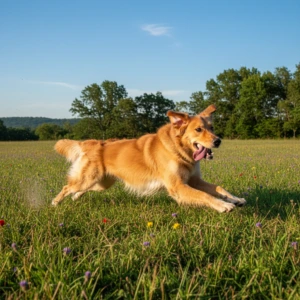
If de-escalation fails and the dog moves to attack, your strategy needs to shift immediately from passive to defensive.
Create a Barrier
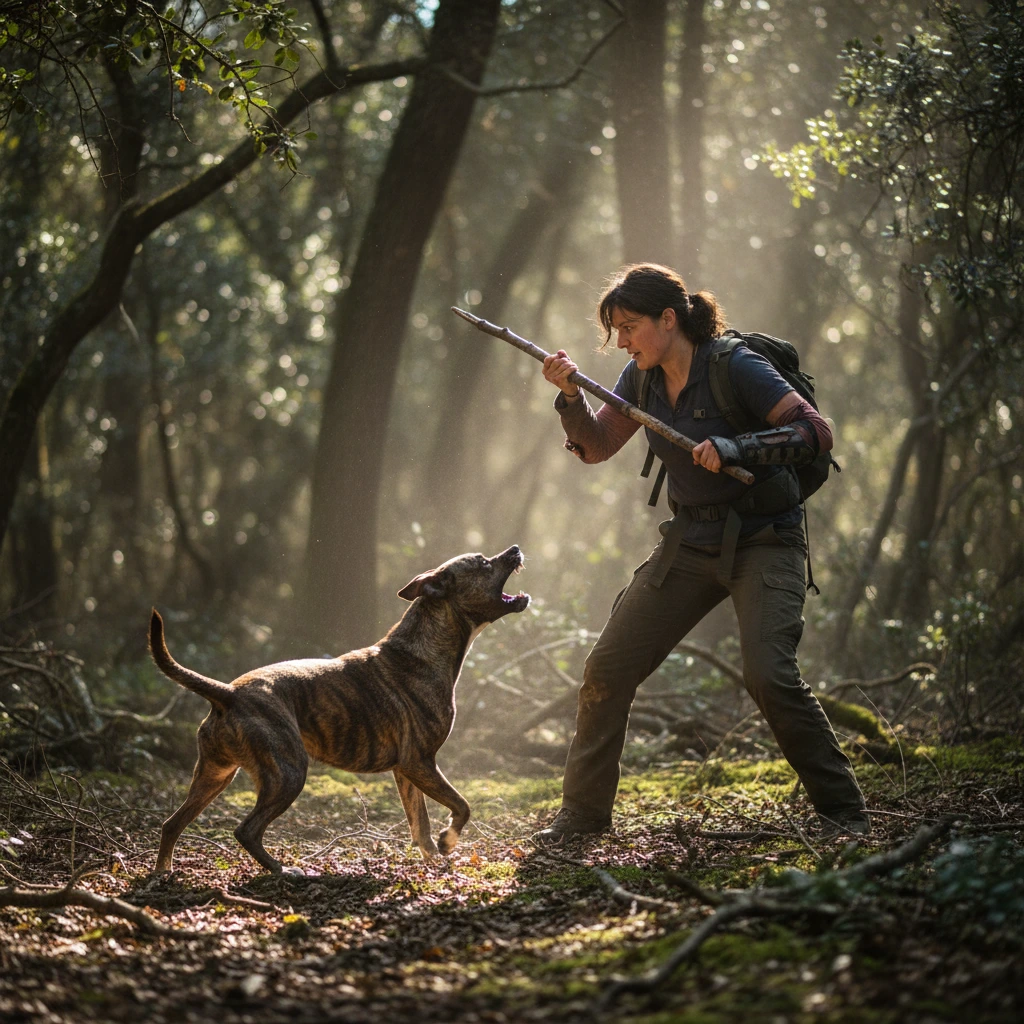
Your priority is to put something—anything—between you and the dog’s mouth. The dog wants to bite, so give it an object to bite instead of your body.
- Use your belongings: A backpack, purse, or shopping bag can be thrust forward to take the brunt of a bite.
- Use your clothing: If you’re wearing a jacket or sweatshirt, you can quickly take it off and hold it out, or wrap it around your non-dominant arm to use as a shield.
- Find an object: An umbrella, a stick, or even your bicycle can be used to create distance. If you’re on a bike, get off and keep the frame between you and the dog.
Protect Your Vital Areas
If you are knocked to the ground, your focus must be on protecting the most vulnerable parts of your body: your head, neck, and chest.
- Curl into a ball: Bring your knees up to your chest to protect your torso.
- Cover your head and neck: Clasp your hands behind your neck and tuck your arms and elbows in tightly to shield your face and ears.
- Stay still and quiet: Once you are on the ground in this defensive position, remain as still as possible. Fighting back can sometimes intensify an attack. By playing dead, you may cause the dog to lose interest.
As a Last Resort: Fighting Back
If you are in a life-or-death situation where the dog is relentless and you cannot protect yourself by curling up, you may have to fight back. Aim for sensitive areas to force the dog to release its grip. Do not waste energy hitting the dog on its skull, which is very thick. Target the nose, eyes, or throat if you are forced to defend your life. This is an extreme measure for dire circumstances.
Phase 3: What to Do After an Attack
The danger isn’t over once the dog retreats. The adrenaline coursing through your system can mask pain and the severity of your injuries. Immediate medical and logistical steps are essential.
Get to Safety and Assess Wounds
First, move to a safe location away from the dog. Then, carefully check for any injuries.
- Wash any wounds: Dog mouths contain a lot of bacteria. If possible, wash any bite or scratch with soap and warm water immediately to help flush out germs.
- Control bleeding: Apply firm, direct pressure to any bleeding wounds with a clean cloth or piece of clothing.
Seek Medical Attention
It is crucial to see a doctor for any dog bite that breaks the skin, no matter how minor it seems.
- Infection is a major risk: Your doctor will likely prescribe antibiotics to prevent a serious infection from developing.
- You may need stitches: Deep lacerations will require medical closure.
- Rabies is a critical concern: If the dog’s vaccination status is unknown, you may need to undergo post-exposure prophylaxis for rabies. Rabies is nearly always fatal once symptoms appear, so it is not worth the risk. For more guidance, you can consult reliable resources like the Centers for Disease Control and Prevention (CDC) page on rabies.
Report the Incident

Reporting a dog bite is a matter of public safety. The same dog could injure someone else, such as a child or an elderly person, if the incident goes unreported.
- Gather information: If the owner is present, try to get their name and contact information, as well as proof of the dog’s rabies vaccination.
- Contact authorities: Call your local animal control agency or the police non-emergency line to file a report. They will document the incident and can take steps to quarantine the dog if its vaccination history is unknown.
- Document everything: Take photos of your injuries, the location of the attack, and the dog itself if you can do so safely.
Your calm and prepared response can make all the difference in a dangerous situation. By understanding dog behavior and knowing these safety steps, you can navigate your community with greater confidence.
Looking to build a better understanding of canine behavior and safety? Exploring more resources on dog Wellness Hub can help make our communities safer for both people and pets.
Frequently Asked Questions (FAQs)
Q: Should I carry pepper spray for dogs?
A: Dog-specific deterrent sprays can be effective, but they require good aim under pressure. Wind can also cause the spray to blow back at you. It can be a useful tool, but it shouldn’t be your only line of defense.
Q: What if the dog’s owner is uncooperative?
A: Your priority is your safety. Focus on de-escalating the situation with the dog first. After you are safe, contact the authorities to report the incident, even if you could not get the owner’s information.
Q: Does staring a dog down show dominance?
A: No, this is a dangerous myth. In the canine world, a direct, hard stare is a threat and is more likely to provoke an attack than to prevent one. It’s always safer to avert your gaze.
Disclaimer: The information provided in this article is for educational and informational purposes only and is not intended as veterinary or professional advice.
About The Author